
Brown County Most Wanted Reality
Don't go looking for a glossy "most wanted" wall in Brown County. The sheriff's site has one. There is no ranked shortlist with photos, no reward money, no Crime Stoppers tip line, and no "Warrant Wednesday" feature. Instead, the county points everyone to the Sheriff's Office Outstanding Warrants page, a searchable name index that rolls the wanted list and the warrant checker into a single tool.
That single tool is deep. Results stretch across 97 pages, and some entries reach back to the late 1990s. So think of it as a broad database rather than a current-only roster. Names can repeat. One person can tie to several court matters. The page posts no update stamp and no removal schedule, so treat every possible match as unconfirmed until an office verifies it directly.
Brown County Warrant Listing Fields
The portal shows compact fields, not narrative profiles. Take each value at face value. A blank cell tells you nothing about what the court file actually holds.
| Field | What it shows |
|---|---|
| Name | The person name indexed by the sheriff; verify spelling and identity. |
| Warrant number | An identifier when populated; a blank field means only that the public field is not populated. |
| Charge or description | The stated basis, including observed failure-to-appear wording; it is not a conviction. |
| Bond | The displayed value when populated; a blank must not be translated into a release condition. |
| Warrant date | The date attached to the listing, not an update or disposition date. |
| Age, sex, and race | Displayed descriptors that may help distinguish names but do not prove identity. |
| Photo | No photograph displays in the official warrant index. |
One caution on identifiers. A warrant number can look like a case number, but the format and punctuation do not add up to a full district-court case number on their own. So run any identifier past the court portal or the clerk first. The bond field carries a similar limit. It says nothing about custody status. It won't tell you whether bond was posted, or whether the terms still stand.
Search Brown County Wanted Names
The official search is simple to use. A reliable check takes more than a glance, though. Don't stop at the first matching name. Treat the sheriff's page as an index. Treat the issuing office as the authority.
- Open the Brown County Outstanding Warrants page.
- Enter the full name. Try a careful spelling variation only when there is a sound reason, such as a hyphenated surname.
- Compare the warrant date, charge text, age, sex, and race only as needed to distinguish possible matches.
- Write down the displayed warrant number exactly when it is populated. Do not infer information from blank fields.
- Call the Brown County Sheriff’s main line at 785-742-7125 to confirm whether the entry remains active and ask which court issued it.
- Use the issuing court or an attorney for lawful next steps. Do not rely on the web result as a substitute for official advice.
The manifest view below comes from the official warrant search itself. It shows the working interface as visitors actually encounter it, without turning the page into a photo gallery.
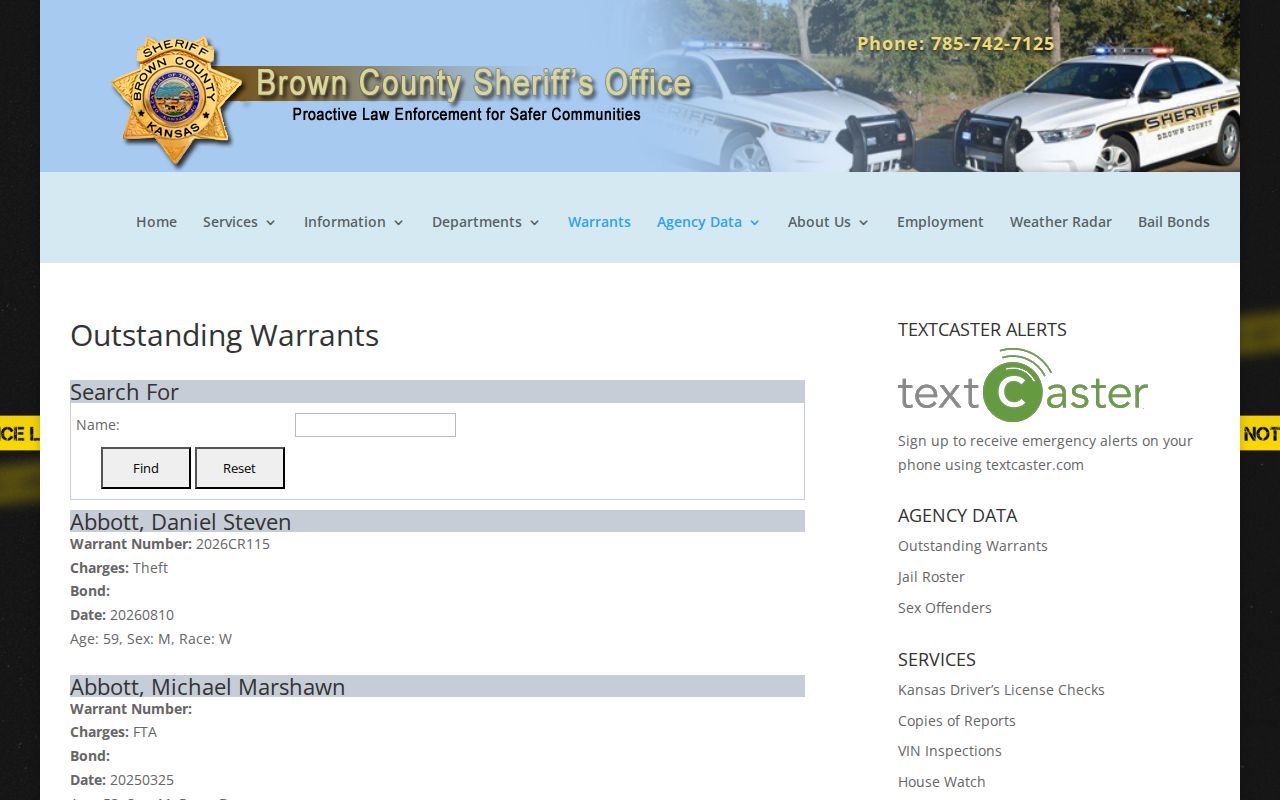
The screenshot shows a name-search index built on plain text fields. No mugshots appear. That matters. It is exactly why the final step belongs to the agency, not the web page.
Brown County Warrant Types Shown
Only the warrant categories visible in the portal's own descriptions can be stated with confidence. Anything more would be guesswork. A full local map of bench, arrest, probation, municipal, and other classes is not possible from here. The narrow table below sticks to what the county actually shows.
| Portal description type | Supported interpretation | What to verify |
|---|---|---|
| Failure to appear | The public entry states that a required court appearance was missed. | Issuing court, active status, case number, and the lawful appearance process. |
| Named alleged offense | The entry states an charge associated with the warrant. | Whether prosecutors filed that count and whether later orders changed the case. |
| Blank or incomplete public field | The public index does not populate that item. | The sheriff or issuing court record; never supply a guessed category. |
A warrant signals one thing. A judge has authorized an arrest. It says nothing about how the case ends, and the supporting affidavit is a separate record entirely. The Kansas Attorney General KORA guidance notes that access rules can turn on the warrant's date and whether it has been executed, and some records require a request through the assigned judge or district-court clerk.
The split is practical, not academic. The sheriff's index can flag a possible warrant and hand you a number, date, charge label, and bond field. An affidavit holds the sworn facts presented to a judge, subject to the access rule that applies. The district-court docket tracks everything filed afterward. None of the three can substitute for the others. Ask for the exact document by case or warrant number. Let the clerk sort out any lawful restriction rather than assuming every related paper is public.
Verify an Old Brown County Warrant
Depth is Brown County's distinguishing feature. The public results span 97 pages. They reach back decades. That makes the index genuinely useful for name searching. The same age and the missing update mark also make stale entries a real hazard. An old date never proves a warrant is still live, and the page count itself can shift at any time.
Verify in two steps. Call the sheriff at 785-742-7125 with the exact name and the populated warrant number. Ask whether the agency can confirm current status and name the issuing court. Then pull the court docket and look for anything filed later. An arrest, a recall, a dismissal, a plea, a judgment, or an expungement can each change the picture.
Write down who confirmed what, and when. If the sheriff points you to the court, hand the clerk the exact identifier rather than asking for a broad name sweep. When the online docket lacks the document you need, request that specific order by name. That builds a clean chain from the index to the live court record.
Note: The public warrant index has no published refresh cadence, so same-day agency or court confirmation is essential.
Safe Brown County Warrant Response
Safety comes before anything else here. If a name on the wanted list matches someone you see, leave the situation alone. Don't follow, restrain, or hold that person. Don't attempt any transport either. Mistaken identity happens, and direct contact can endanger bystanders as well as the officers who respond. Call 911 the moment there's an immediate threat. For anything less urgent, the Brown County Sheriff's main line at 785-742-7125 takes non-emergency information. There's no stated reward program and no promise of anonymous tips, so treat both as unavailable.
Safety: Never approach a listed person. Call 911 for immediate danger, and route non-emergency tips to the sheriff.
Believe the warrant points at you? Contact a lawyer or the issuing court. Either one can explain a lawful path forward, including where and when to appear. The goal is safe resolution, not dodging service. This page should never feed plans for travel, concealment, or any other effort to evade law enforcement.
Brown County Sheriff’s Office
Main and non-emergency: 785-742-7125
Address: 709 Utah Street, Hiawatha, KS 66434
Records: Cynthia Linck, 785-742-3188
Brown County Court Follow-Up
Begin with the court that issued the warrant. From there, open the Kansas Judicial Branch District Court Records page and enter the statewide public portal. Smart Search allows filtering by name, county, filing window, and case type when the interface permits. Watch one timing quirk. The date a warrant was issued and the date the case was filed do not always match.
A docket is only a match after you compare the details. Look at the party names, the county, the case type, and the filing date. Then check the attorneys, the judge, and the order of events against the warrant entry you started from. If the pieces line up, you have the right file.
The original complaint shows what prosecutors filed that day. Nothing more. Later status is governed by what follows: amended complaints, dismissal entries, pleas, judgments, sentencing orders, and expungement orders. A hearing on the schedule may never have taken place. A bond order is not an outcome. When the portal shows only metadata, use the courthouse public terminal or ask the clerk to pull a specific document tied to a verified case number.
Some files stay off limits. Kansas court rules seal juvenile cases, expunged matters, and certain child-related proceedings from public view. A search that comes up empty means little on its own. The name could be misspelled, the filing could be too new, or the case might simply fall outside what the system releases. Steer clear of cached private pages or social media posts when you hit a wall. Protected cases can't be pieced together that way, and trying invites more trouble than it's worth.
Wanted Status and Brown County Custody
Think of the warrant index and the jail roster as two different pictures. One lists outstanding warrants the sheriff makes public. The other shows who is actually sitting in Brown County Jail right now, complete with booking photos on each inmate card. Someone picked up on a warrant often lands on the roster later, though the sheriff gives no timetable and keeps no archive of people once released. For that current-custody path, the Brown County booking and custody guide lays it out.
Kansas VINE handles a separate job: custody notifications for participating county jails. It won't alert you to warrants. It also skips state prisons, juvenile facilities, and federal detention entirely. Textcaster, CivicPlus Notify Me, and SMART Alert are community emergency tools, not named-person warrant notices. Brown County has no sheriff mobile app or verified social wanted feature.
For official public-safety links and contact details, the Brown County Sheriff homepage is the place to start.
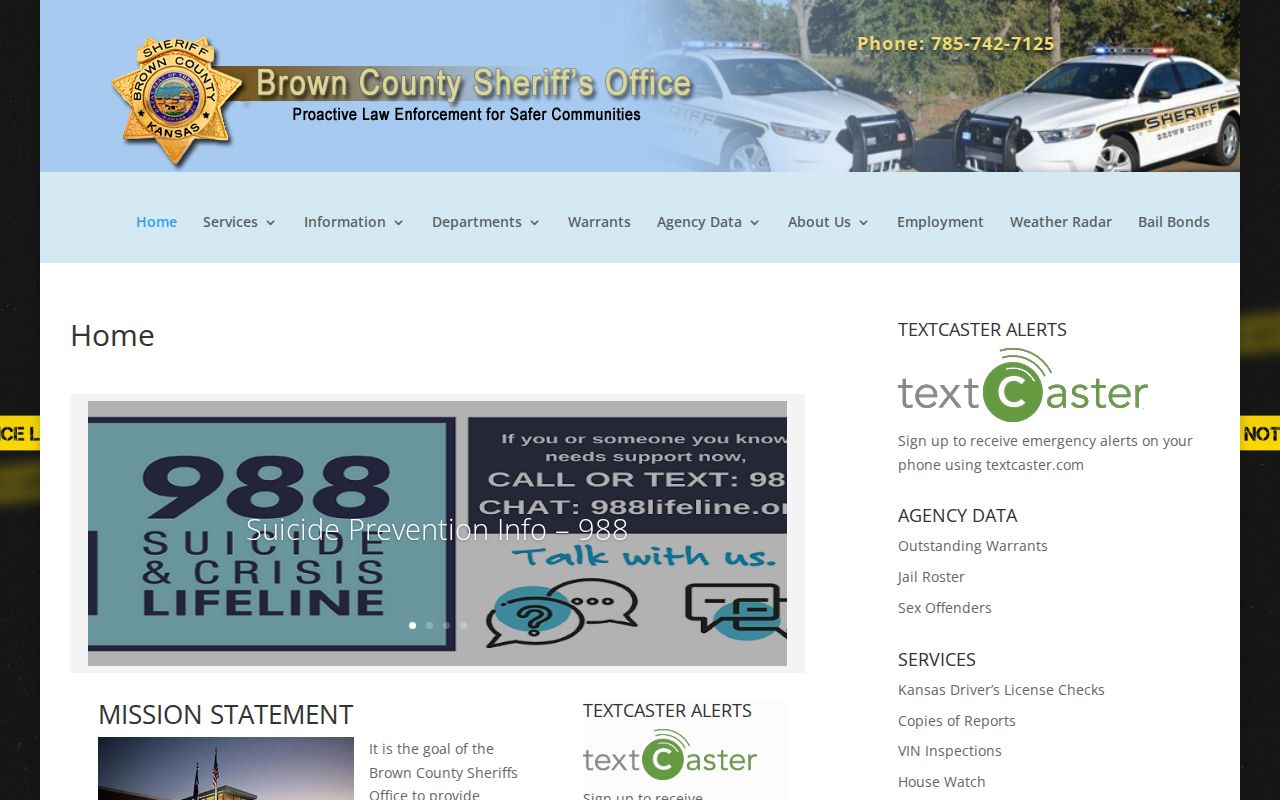
The site's navigation makes it easy to circle back to the agency itself when you need current verification. That beats trusting a stale result or an unofficial repost every time.
Public Record Search
Sponsored Results